Here’s another post about my literary influences. It would seem rather pretentious to claim Shakespeare as an influence on my infant self. His language was not exactly easing reading for a child in the 1960s – probably even less now, unless it could be conveyed entirely by emojis. And it isn’t just the language that can be a problem. Shakespeare’s idea of humour, in the Comedies, still remains a complete mystery to me, and some of the themes are profoundly distasteful, despite academic attempts to make them politically acceptable.
Even so… you know, Shakespeare! Where would we be without him? I’m only being cruel to be kind, but for goodness’ sake, you’d be on a wild goose chase, and get in such a pickle, laughing yourself into stitches, if you decided to go through life without using any of his phrases. But that is neither here nor there.
My mother liked Shakespeare and always had a battered copy of the complete works to hand, but it was through another medium that I was drawn in. It was still thanks to my mother, because she was working as a temp secretary at various firms around town, one of which – well, I don’t really know what it did. Maybe something to do with insurance, but in the course of her work she was offered some salvaged LPs from a fire-damaged warehouse. Their labels were a bit wet or torn, but otherwise they were intact. Amongst the half dozen Tchaikovsky and Beethoven records were four recordings of Shakespeare plays – abridged, admittedly, and mostly featuring Richard Burton: Macbeth, Hamlet, King Lear and Henry V. Listening to Shakespeare delivered by professional actors (as opposed to hopeful Fifth Form students) made it far more accessible, and I liked them all. But the one I really loved was Henry V.

As political correctness of message goes, Henry V is one of those Shakespeare plays scoring nul points. Henry was an imperialist warmonger, and Shakespeare glorifies him in that role. To my mind, concocting some ridiculously feeble excuse for claiming the crown of France in order to launch into a totally pointless war, just to divert attention at home from the fact that he was the son of a regicidal usurper, is not grounds for claiming greatness.
Then there was his failure to understand the basics of gene inheritance by insisting on marrying the daughter of the totally doolally King of France, giving rise to a bonkers son and the Wars of the Roses. And he was a nasty religious bigot with a penchant for burning heretics.
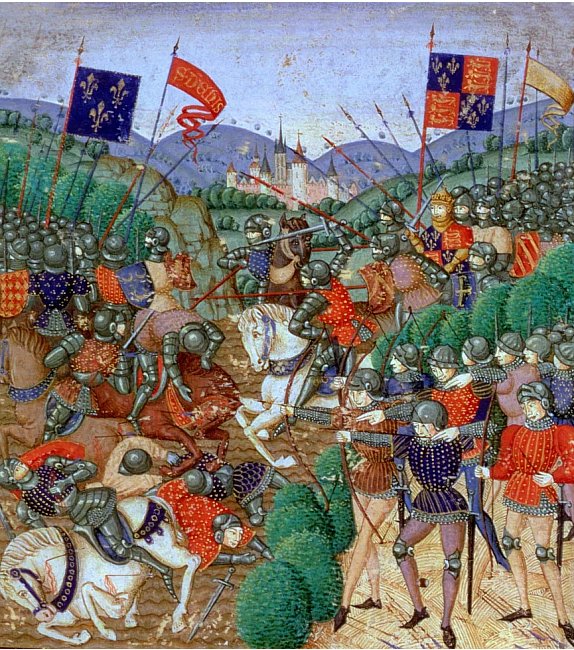
Okay, he did win a very impressive battle, in line with Crécy and Poitiers, demonstrating that a small, disciplined semi-professional force is better than a huge horde of self-serving feudal idiots. You can see why it was the obvious choice for a Laurence Olivier film made to boost morale in World War II (leaving out awkward bits about treachery).
That aside…
The play was very useful in teaching me some basic French, more effectively than school lessons. Le foot, et le count. O Seigneur Dieu! But its real impact was the use of the English language, not as learned by Katherine, but as spoken by Chorus (aided by the Duke of Burgundy). Henry V is the play that spells out in CAPITALS that the audience is watching actors on a bare stage in a round theatre and they are going to have to use their imagination to conjure up the scenes Shakespeare wants them to see and hear – the English fleet preparing to sail for France; two armies on the night before battle, camp fires flickering, the air ringing with the sound of hammers closing rivets up and the neighing of warhorses; the war-ravaged countryside of France; triumphant London.
Yes, the king in Henry V has some stirring and very quotable speeches, always good for launching into when slightly tipsy after dinner. But it’s Shakespeare’s use of the Chorus in Henry V that makes the play a delicious exercise in descriptive writing. It’s poetic, of course, because it’s Shakespeare, but it’s also prose at its best, forcing the reader (or listener) to engage as a partner in the creation of the piece. Make them work. Battles are tedious but the Chorus is thrilling.
 Thorne Moore
Now I need to go and look up the chorus!
LikeLiked by 1 person
any excuse for rereading the Chorus is good.
LikeLiked by 1 person
Sadly, Henry V is not one of my go-to Histories and I ought to read the whole caboodle. Ought to, but probably won’t….
LikeLike