Twenty Years After, or more correctly Vingt Ans Après, by Alexander Dumas, is an adventure story about the frustrated career of a man called Dart. I lie, of course. He’s really called D’Artagnan, but that was a totally mystifying collection of letters that I couldn’t get my head around at all. If you don’t know it, it is the sequel to The Three Musketeers, and you would think I came to it after reading the first book. But no, it was some years before I discovered there was a first book. I came to it from Janet and John Book 2.
The plot: D’Artagnan was upgraded to lieutenant in The Three Musketeers, but he is still a mere lieutenant 20 years on, having been forgotten by the Queen he served. Cardinal Richelieu has given way to Cardinal Mazarin, Louise XIII has given way to the boy king Louise XIV under the guidance of his mum, Queen Anne, and France is about to have a mini revolution called the Fronde. Old friends find themselves on opposite sides, with D’Artagnan and Porthos in the service of Mazarin and Athos and Aramis trying to confound him. Never mind the ins and outs. The villain of the piece is Mordaunt, an agent of Oliver Cromwell, who turns out to be Milady’s son, bent on avenging his mother by bumping off the gentlemen who were so impolite as to cut her head off. They all find themselves in England, where they decide to save Charles I from execution. They fail and… never mind the rest.
The appeal of the book, to me, was the chapter in the middle called REMEMBER! which is all about the execution of Charles I. I was about six, I think, when I found the book, a little volume from the Everyman Library of Classics, on my grandfather’s shelves. I had begun to read before I started school, just by being read to, I expect, and having Rupert annuals to browse, but I had, at best, mastered the simplest basics.
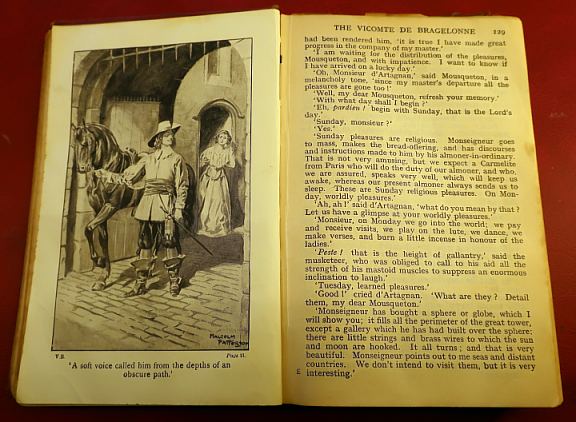
The first appeal of Twenty Years After was the fact that it was illustrated. Adult books tended not to be, and were therefore boring, but this was old school fiction, with illustrations – just five or six, scattered through the pages. Very nice pictures with very romantic costumes – Puss in Boots meets Cinderella. Having hunted through to find all the pictures, I came across that middle chapter with the one-word title – a long word but not too difficult to spell out. And in it were mentions of a head being cut off.
Children are not sweet little kittens. They are little kittens curious to see what the inside of a mouse looks like. As a child I saw Peter Pan on Ice, but I read the book (J M Barrie’s book of the play) as an adult and I was mildly shocked by a description of the children avidly reading newspaper accounts of executions. Then I remembered that I had read about the execution of Charles I just as avidly.
I read that chapter, REMEMBER! Or rather, I stumbled through it, picking out whatever words I could manage. Then I read it again, with the previous chapter and the one following… and so on, until I had more or less read the whole book, probably managing one out of every two or three words. No idea if I made any sense of it. Probably not. But I went on to read it again, from start to finish, and that time I managed maybe two out of every three words. I filled in what I couldn’t read. It probably took ten complete reads before I gave up calling the hero Dart, and made a wild stab at D’Artagnan. Twenty before I got it right.
Meanwhile, at school, I was working my way, with extreme boredom, from “Look, Janet, look, see the big red ball,” to the unappetising promise of stories about some chicken that thought the sky was going to fall in. It didn’t do it for me. Give me decapitation of kings any day.
I could say that the story of Twenty Years After was an inspiration for me by teaching that questions of right and wrong are often complicated, and there is seldom a neat dividing line between goodies and baddies. It did give me an abiding fascination with the 17th Century, and pre-Napoleonic French currency. But the real inspiration was simply the existence of words waiting to be read. Twenty Years After taught me to read, or allowed me to teach myself to read. It was light years beyond my reading age, so I ran and ran to catch up. I never felt the urge to run with Janet and John.
I struggled. I moved from grasping the easiest words to having a guess at the more difficult ones, spelling bits where I could, and somewhere along that struggle, the miracle happened. I could read.
Once we have mastered reading (those of us that do), something clicks, and all the methods that we used to learn it go out of the window. We don’t spell out each word, unless it’s something entirely novel that confounds us. We don’t even see sentences consciously word by word anymore. They are just absorbed by our brains in a steady stream of anticipated meaning, so smooth that we gloss over misprints and misspellings without even noticing. Well, mostly.
So I am deeply grateful to Dart and his friends, Athos, Porthos and Aramis, for the gift that I am sure I would never have gained from Chicken Licken.
Twenty Years After: Get it FREE on Kindle.
I should add that I also had a 2 volume set of Carlyle’s French Revolution, with pictures of guillotines, but they didn’t have the same appeal. The costumes were too silly.


I was going to buy it anyway, halfway through reading this piece – but the handy click link helped! It’s a salutory lesson for teachers, although I think you’re in a minority of children who had the vocabulary, through being read to and treated as an adult, to make sense of the piece and have that fire to work it out.
LikeLiked by 1 person
Thanks. I suspect it took years before I really made sense of any of it, but the mere struggle with it made it much easier for me to immerse myself in children’s books. I can’t remember doing very much at all as a child except read.
LikeLiked by 1 person