I know town cemeteries are beautifully maintained, neat, trimmed, numbered and carefully recorded, regimented for ease of access, but if you really want to rest in peace you can’t beat a country churchyard and Nevern has the best. Cross the narrow bridge over the Nyfer, and there it is.
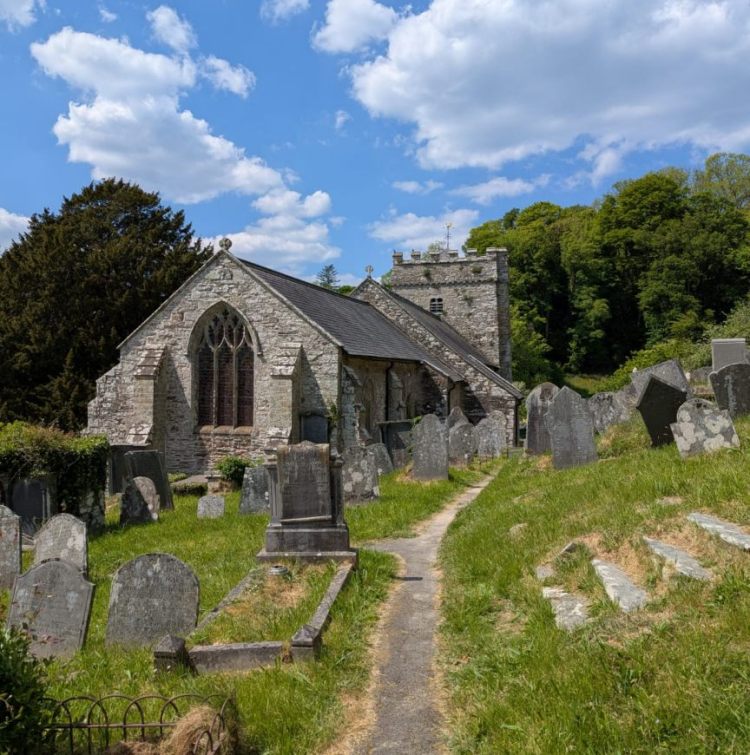
In the heart of North Pembrokeshire, surrounded by diminutive Welsh churches with a belfry at best, Nevern church, with its massive tower, is stoutly Norman English in appearance. But it’s dedicated to the very Welsh St Brynach.

As well it might because the site goes back way before the Normans. There’s a theory that ancient yews in churchyards predate the churches themselves and mark older pre-Christian sites. I don’t know how old the Nevern yew trees are, but they certainly give an impression of extreme age.

More than that, they bleed. I’d bleed too if someone lopped a limb off. But despite the blood, and the deep shade of the yews, there’s nothing gloomy about the churchyard, even though the dead have been buried here for centuries.

Lots of centuries. This is the Vitaliani stone. 5th or 6th century. Yes, it probably originally stood somewhere else but it so obviously belongs here. It has inscriptions in Ogham and Latin, reading Vitaliani Emerato. I know this because I keep reading that that’s what it says, but I have never been able to make out any of it.

Inside the church, incorporated into one windowsill is an ogham stone that is much clearer. Ogham was an alphabet developed in Ireland (Pembrokeshire was colonised by the Irish), designed for carving on stone, the letters made up of lines scored above and below a dividing line (usually the corner of a stone). This stone reads MAGLICUNAS MAQI CLUTR in Ogham, and for ease of reference it’s also inscribed in Latin: MAGLOCVN FILI CLVTOR (Maglocunus son of Clutorius).

In the adjoining window sill is a tenth century Celtic entwined cross.

Even more impressive is the cross that stone outside the church, 10th or 11th century and standing 13 feet high, intricately carved. Beat that.

You can get a lot of inspiration in graveyards. The wilderness of Nevern churchyard is scattered with graves, of course, and it’s possible to spend hours peering at them for glimpses into a lost past. The oldest I’ve found stands by the tower and is almost illegible, but you can just make out the date, 1695.

The earliest inscriptions are not carved deep (or skilfully). The local stonemason was fairly free and easy when it came to fitting words to a line.
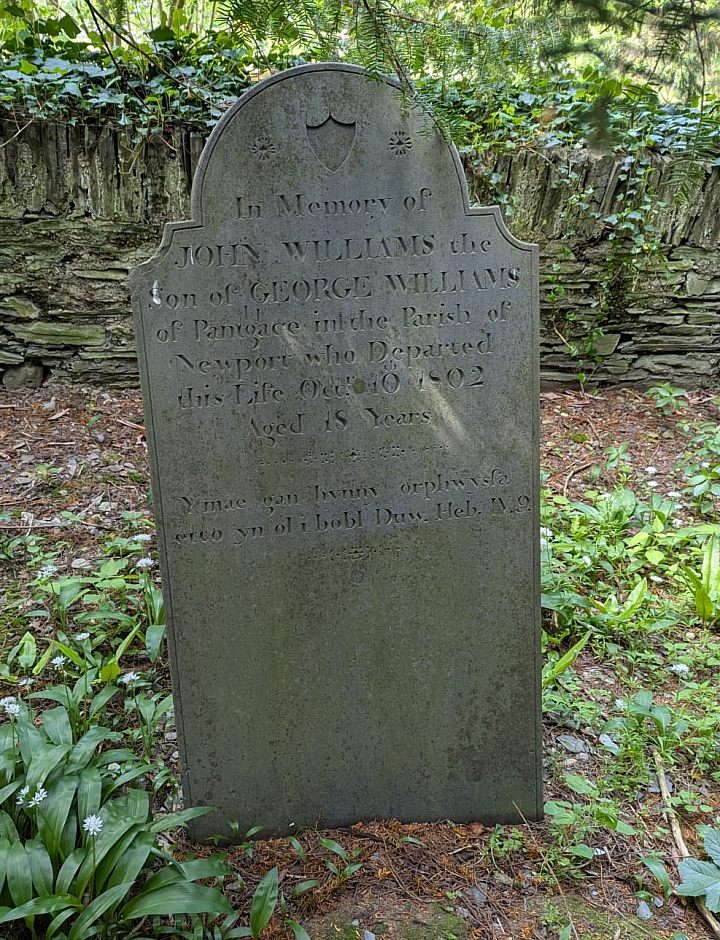
Later inscriptions improved.

The carved urn at the top of this one is quite elegant, though the cherubs to either side are slightly reminiscent of ancient Celtic heads. Or maybe just not very good.

I love this one, 1745, with carvings best described as naïve?

Serious raised tombs really need good foundations. These look as if the occupants make regular visits elsewhere. With so much wild garlic around, at least they are unlikely to be vampires.
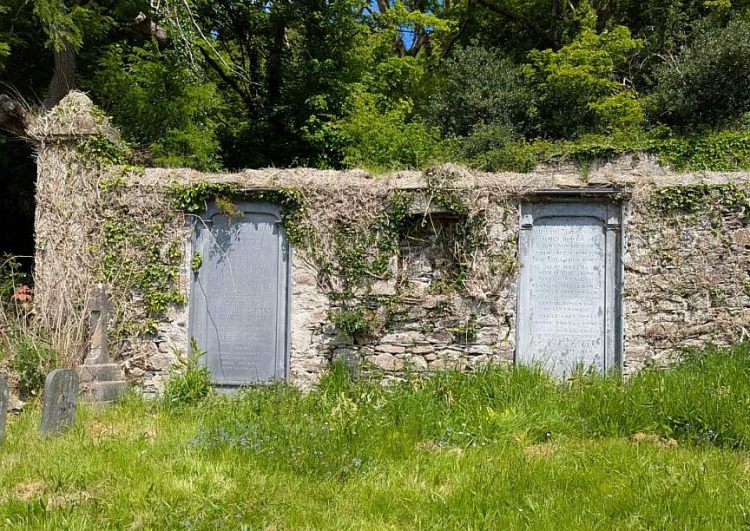
There are some serious family vaults that proclaim the importance of their families.
The late Georgians dealt with death in a very civilised manner by resorting to poetry. And why not?

Hush’d be our sighs,
suppress’d the trickling tear,
to sad remembrance of their merit just.
Nor will we mourn
For they to us were dear
And still are dear
Tho buried in the dust.
This one has to be the winner, dedicated to dead infants, Anna Letitia and George Griffith.
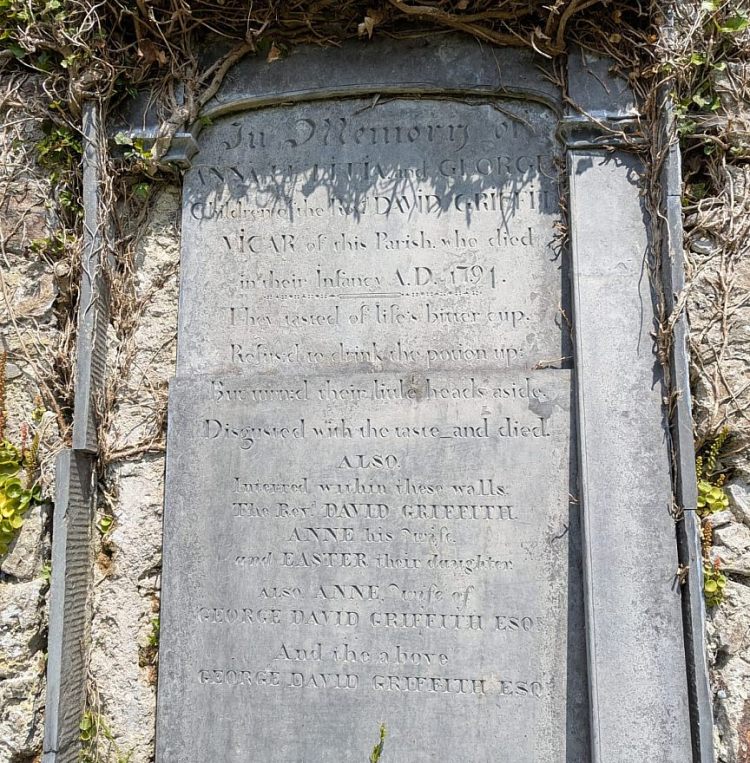
They tasted of life’s bitter cup,
Refused to drink the potion up,
But turned their little heads aside,
Disgusted with the taste – and died.
A more modest stone is just as heartfelt.

Underneath the flow’ry sod
Lies this rosebud, withered, dead.
Sisters, mothers, on her grave
Drop a tear of woman’s love.
Fathers, brothers softly tread
Where our gentle Blanche is laid.
Some inscriptions, though, don’t need verse to speak volumes.

The children of John and Ellen Richards
Mary, aged 3 months; David aged 2 years; Rachel aged 3 years, Jane aged 11 years, Margaret aged 15 years, Thomas aged 4 years
Lovely and pleasant in their lives, in their death they were not divided.
Death sucks, but at least Nevern churchyard is a peaceful place to finish up.
 Thorne Moore
I love these photographs and ancient church yards. Many years ago, My Mother used to make grave stone rubbings…..which can be so beautiful. Thank you.
LikeLike
thank you for visiting. Churchyards can be very life-affirming places, can’t they?
LikeLike
I do enjoy wandering through old churches and their churchyards, but this one tops anything I’ve seen so far in terms of antiquity and variety.
LikeLiked by 1 person
Thanks. It’s one of those places where the present sits very lightly on the past.
LikeLiked by 1 person
That’s a description that will stay with me.
LikeLiked by 1 person