My favourite subject, ever since Junior School more than half a century ago, was and is History and the thing that first gave me a grasp of its significance was this poster on a classroom wall, courtesy of National Savings (something I didn’t notice back then). Ladies’ costumes (British) through the ages. Yes, terrible colour, thin cheap post-war paper and some odd choices, but still fascinating.
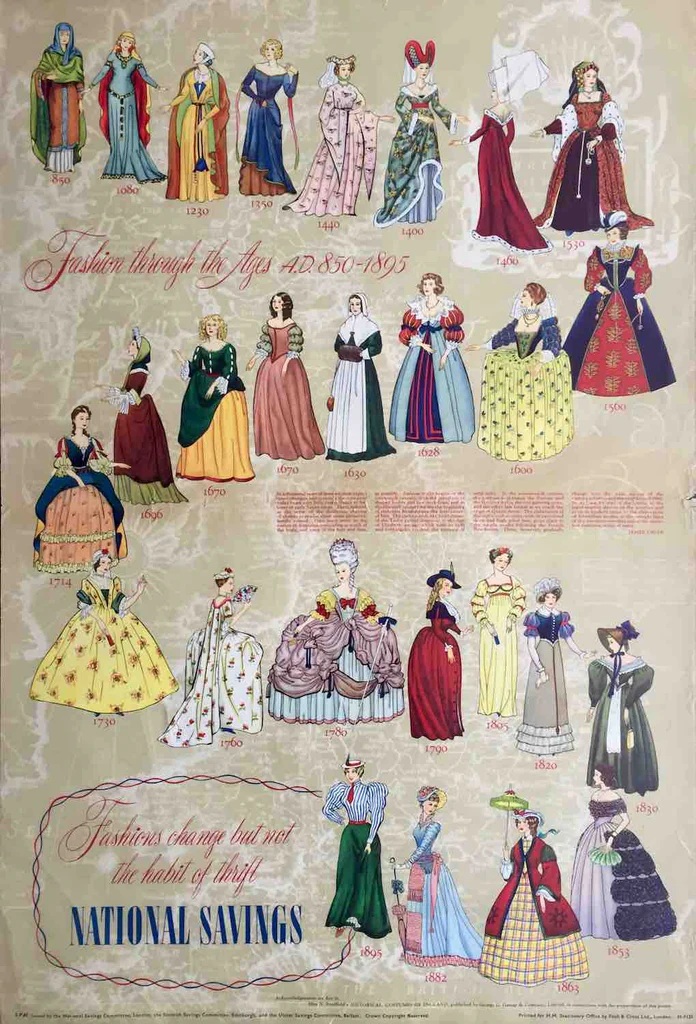
I don’t think the boys were involved, but we girls had to sew small pink felt dolls, which we could then dress in one of the costumes on the poster. The very best teacher’s pet needleworkers got to dress their dolls as Madame de Pompadour or Anne Boleyn. I did go on to become a very proficient embroiderer but straightforward sewing to join bits of material together has always been an issue for me. By the time I had finished my grubby grey lump of dissolving felt, its stuffing oozing at several points, my teacher gently suggested that I dress mine as the Saxon woman, by wrapping a couple of bits of cloth around it.
As a lesson in needlework it didn’t do me much good, but as a lesson in history it was magic. There’s an Iron-age site near me, where visiting school children aged 8 or 9, who are still coming to terms with the idea that time did exist even before their grandparents, are invited to learn about life 2000 year ago. Quite often, they haven’t yet even got their heads around eras when there was no electricity, no television or when food didn’t come sealed in plastic from supermarkets. They haven’t grasped the notion of 100 years, let alone 2000. Whereas I had that poster to show me, in perfectly understandable pictorial form, that time is a continuous process and history is just one damned thing after another.
Who said that? Not the Duke of Wellington, whatever my father claimed, but whoever it was, he captured the most fundamental truth about history. It is not a jumbled collection of unconnected moments, events and damned things, but a continuous succession, each moment arising from the previous moment and giving birth to the next. You cannot understand any period in history without understanding what led to it, and flowed from it.
Ladies’ costumes might seem a very frivolous issue to learn from, but it works, You see the gradual progression from all-in-one robes to fitted bodices and skirts, from loose gowns to rigid hoops and back again, from glamour to plain to extravagance to practicality, one damned thing leading to another. Superimpose them on the long string of invasions, disease, economic expansion, religious dispute, civil war, imperialism and trade and it all flows together. I was able to grasp how a thousand years could roll by, with constant change, depicted before my eyes. The images stopped at the end of the 19th century, but in the early 1960s, even before the mini-skirt burst on us, I’d already learned that change continued into the startling revelation that women actually had legs. I knew this because my mother and grandmothers wore skirts whose hems were all the way up to their knees. And since things called slacks were already around, I could probably have foretold the coming of an age where women could wear jeans, shorts, leggings, harem pants and any manner of garment that acknowledged the existence of lower limbs, offering them the same mobility as men.
Mobility was, of course, hampered by all those dresses on the poster. The images were a lesson in history to me at ten, and a lesson in feminism to me at twenty. The thing about those long skirts is that they constrained movement and kept women limited and vulnerable. Depriving women of any acknowledged body from the waist down was a trigger for both prudery and titillation. If they didn’t appear to have two legs, there couldn’t be anything between, or at least nothing accessible to anyone except their male owners. But men secretly knew and forbidden knowledge is such a thrill. The mere glimpse of a woman’s ankle could be enough to send a Victorian gentleman rushing to take a cold bath. Before the adoption of big knickers, men who didn’t care about permission knew they could rape a woman just by lifting those skirts. Hence the iron chastity belts of the Middle Ages. Joan of Arc was condemned as a devilish witch in part because she refused to dress as a woman even in prison. It wasn’t because she was transsexual or transvestite, (might have been, but who knows). Primarily, it was because she wanted to keep herself safe from the men around her.
If developing fashion eventually offered liberation (not always accepted) to women, it had a miserable effect on men. Up until the start of the 19th century, men with money could be as gaudy, extravagant and frivolous as their ladies. If you want to see someone in silk stockings, flounced skirt, braided and bejewelled frock, embroidered linen and feathered hat, just look at a portrait of Henry VIII. But then it all fizzled out into dull black, grey and brown suits, which have stuck with us every since. Flower power in the 1960s and 70s offered a little flurry and colour, but all we have now is Michael Portillo’s pink jacket. So sad.
Anyway, there’s history for you. Sometimes up, sometimes down. With a few adjustments and updates, I would suggest having a copy of that poster on every classroom for seven-year-olds, to give them the beginning of perspective on the passage of time.


I love that poster. I agree, it is a great history lesson.
LikeLiked by 1 person
I still see different periods in terms of that poster
LikeLiked by 1 person
I do find that poster fascinating. The outfit just before Madame de Pompadour with the huge saddlebags design puts child-bearing hips in a category all of their own.
LikeLike
quintuplets?
LikeLike