It’s amusing, or it would be if it didn’t carry such nasty overtones, to read indignant claims that Britain is a Christian country. Those racist, anti-immigrant overtones have become so strident, usually voiced by people who have never been anywhere near a church, that it has become impossible to have a sensible discussion on the subject. Is Great Britain Christian? No, it’s not obligatory. Anyone can belong to any religion and a third of the population apparently reject all of them. Of those who would opt to tick the “Christian” box, most probably do so without believing anything specific or giving it any thought. We seriously don’t do Christian Nationalism. The UK is deeply and profoundly secular, while still hankering after the pretty trimmings and the vaguely spiritual dressing for important moments like weddings, funerals and coronations.
We are secular because we became a democracy, which meant we gradually dropped the need for deference, to the squire or the parson. It doesn’t mean we have to deny the deep-rooted contribution to our heritage of the Christian church. It has been here, helping, hindering, enforcing, educating, manipulating, healing, torturing, dominating, persecuting, protecting, inspiring and keeping us in our place for nearly two milllenia. It infiltrated our imagery, our stories, our holidays, our architecture, our social organisation, our education, laws and government. And our language. Shakespeare gave us a host of words and phrases, but so did the King James Bible. The Bible did what all allegedly divine scriptures do: it gave us a covering excuse to do whatever we decided to do – kill or don’t kill, love or hate, wage war or make peace – and it gave us ammunition to use against anyone who disagreed with us.
Againt those who claim we should be united under a Christian banner, we have centuries of Christianity doing its best to divide, or to unite by force. In the so-called Dark Ages, we had the Celtic church in Ireland, Wales, Scotland and Northern England, vying with the Roman Church in southern England, with the Roman version coming out on top as the result of the Synod of Whitby (664), because a king and his queen couldn’t decide on the timing of Easter. We had conquerors claiming the right to command and suppress by virtue of being anointed with a bit of holy oil. We had Henry II fighting it out with Thomas Becket, Archbish of Canterbury, over whether churchmen were subject to civil law (something they still have trouble with). We had Christian thugs grabbing the offer of free entry to Heaven if they would just go and slaughter some Muslims (and nab a bit of land and loot in the process). We had Jews living here, sometimes being tolerated and exploited, frequently being butchered, until 1290, when they were expelled – and finally readmitted in 1656. Meanwhile we had growing anti-clericalism after the Black Death, the Statute of De Heretico Comburendo 1401, allowing perceived heretics to be burned at the stake.
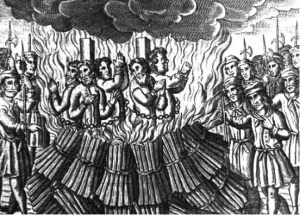
Then we had Henry VIII’s own version of Brexit because he was in need of a fertile wife, Elizabeth I’s religious settlement (bit of this, bit of that, but everyone must accept it), up against a Pope giving blessings and forgiveness to anyone who assassinated her, Catholics trying to blow up King and Parliament and extreme Puritans flouncing off to America to do their own versions of persecution, Charles I causing civil war because he believed in the divine right of kings and Parliament allowing the imposition of a Taliban regime, the Church of Scotland being firmly Presbyterian, while the Church of England insisted on being episcopalian, but very strictly Protestant, until the Oxford movement in Victorian times decided it was actually really Catholic, the Methodists splitting off from it, middle-class Victorians wringing their hands over the persistent lack of religion among the urban lower orders and the Welsh opting out of the Established church (and its demand for payment of tithes) in 1920. We had Muslims, Hindus and Sikhs settling in the country with their own forms of worship, the first mosque being founded in Britain in 1889 (by a native English white Muslim!). And we had Northern Ireland.
It is absurd to deny the role and influence of Christianity through our history. It is equally absurd that we claim to be a Christian country now. What sort of Christianity are we supposed to espouse? That of St Colombo or St Augustine? Of Henry IV or Edward VI or Bloody Mary? John Wesley or Cardinal Newman? We have evolved in and out of all possible versions, to finish up where we are now: secular, rational and hopefully tolerant, with a love of little nativity scenes under Fairy-lit Trees, the sound of Carols from King’s College and the Pogues in the background, before settling down to a Christmas showing of Where Eagles Dare, then onto chocolate eggs at Easter, August bank holiday, lights at Diwali and yummy snacks at Eid.
Please, let’s keep it up.
 Thorne Moore